Why Wet Roads Catch Even Experienced Riders Off Guard
Cycling in rain has become tricky with all the bad advice flying around. Slow down. Stay calm. Trust your tires. None of that prepares you for the moment your front wheel vanishes from under you on a crosswalk you’ve crossed a hundred times before.
As someone who commuted by bike through Seattle for five years, I worked through the fundamentals of wet pavement the hard way. Today, I will share it all with you.
Here’s what nobody explains properly: grip loss in rain isn’t gradual. It’s a threshold event. Your tires feel completely fine at 12 mph, then betray you catastrophically at 14 mph — on the exact same road, same corner, same everything. The difference is you’ve crossed some invisible line where water depth or an oil sheen finally overwhelms what your tread can handle. The road doesn’t negotiate.
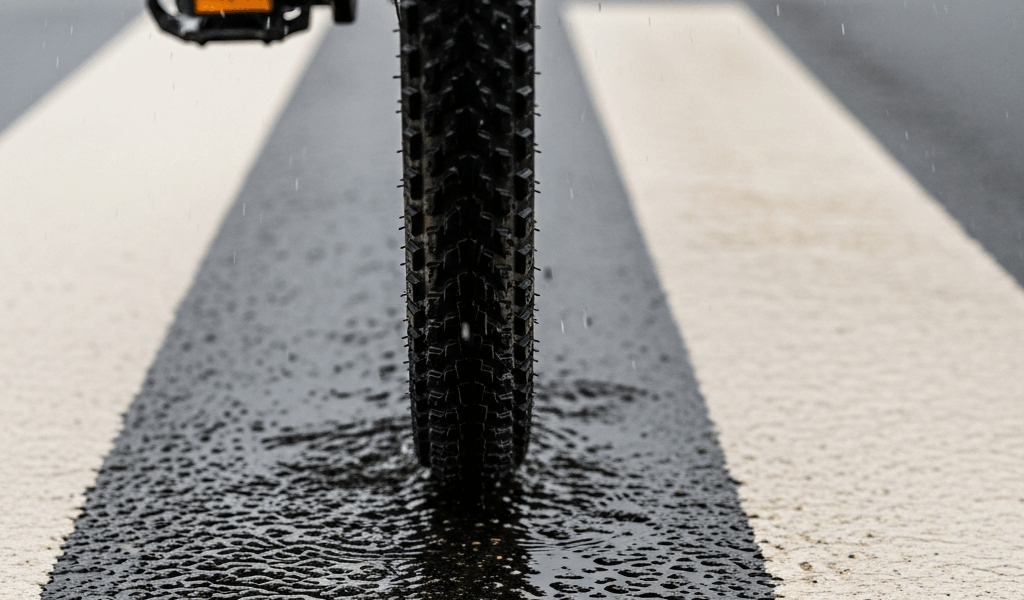
Three surfaces punish cyclists hardest when it’s wet. Painted road markings — crosswalks, lane indicators, all of it — turn into skating rinks. Paint fills in asphalt texture. Smooth surface, zero grip. Metal storm drain grates are worse. Water pools on top of metal and creates a hydraulic layer with almost nothing for your tire to bite into. And wet leaves packed against the curb? More treacherous than ice, honestly, because they look like just leaves. They compress into slime under your wheels. You can’t see what’s happening until it’s already happened.
Most riders know to slow down. But what is actually happening under your tires? In essence, it’s a constant negotiation between tread pattern, water displacement, and surface texture. It’s much more than that, though — and understanding it changes how you ride entirely.
Braking in the Rain Without Going Over the Bars
The instinctive grab kills people. Something feels wrong, your hands tighten, and you squeeze the front brake hard. Front wheel locks. Your body keeps going forward. Gravity settles the argument. That was probably 0.3 seconds from concern to crash.
Dry conditions give you a workable 70/30 brake ratio — 70 percent front, 30 percent rear. Rain changes that to 60/40. Rear brake takes on more responsibility. This feels wrong because your front brake is objectively more powerful. But power in wet conditions creates lock-up, and lock-up creates slides. So, without further ado, here’s what actually works: feathering.
Squeeze the brake lever the way you’d test a hot pan — gradually, almost gently. Apply pressure over two or three full seconds rather than a fraction of one. If the wheel starts sliding, you’ll feel it immediately through the handlebar. Ease off, then reapply. Pulse it. Your fingers need to stay ready to release at the first hint of anything going wrong.
Rim brakes versus disc brakes matters here more than most guides admit. Rim brakes have a lag problem in heavy rain — water builds a film between pad and rim, and you get a one-to-two-second delay before braking force actually arrives. That’s enormous. Start braking earlier than feels necessary. Earlier than that, honestly. Disc brakes eliminate the lag because the rotor sits inboard, away from spray. I ride a Specialized Diverge with disc brakes now, and the difference on my morning commute over the Fremont Bridge was night and day compared to my old rim-brake setup. Still not magic. Modulation still matters.
How to Corner Safely on a Slippery Road
Lean less. That’s the whole thing. It feels completely wrong until your hands remember it.
In dry conditions you lean the bike while keeping your body relatively upright — the two angles separate. Wet corners flip the priority. Lean your body more, lean the bike less. Keep the tires more vertical beneath you. A vertical tire uses its full tread width. A leaned tire relies on its outer edge, which has less rubber in contact with the road and less grip to offer.
Look further ahead than feels natural. Target fixation is genuinely dangerous — if you stare at the wet patch you’re trying to avoid, you will ride directly into it. Your body goes where your eyes go. Fix your sight line 15 to 20 feet ahead, past the corner. Let peripheral vision handle immediate hazards. Your hands will react to what your eyes track without you consciously steering.
Brake before the turn. Not during. This is non-negotiable — at least if you want to keep both wheels underneath you. Braking while turning splits your traction demand between two things, and wet pavement doesn’t have enough grip for both. Finish braking, reach your apex speed, then exit clean. Mechanical? Yes. That’s the point.
There’s a drill worth doing twice a year. Find an empty parking lot after light rain. Roll at 8 to 10 mph and practice corners at progressively shallower lean angles. Feel where the bike starts giving you feedback. Find the edge before the road finds it for you. Twenty minutes of this builds muscle memory that carries through six months of wet riding. I do this every October and every March — usually in the lot behind the Fred Meyer on Aurora. Not glamorous. Works every time.
The Gear That Actually Reduces Fall Risk in Rain
Worth saying out loud. People always want gear advice first. But skills reduce falls more than equipment does — that part needed to come first. That said, three specific things genuinely matter for safety, not just comfort.
First, you should check your tires — at least if you’re running anything marketed as fast or aero. Continental Contact Plus or Schwalbe Marathon tires aren’t exciting, but they shed water actively. Fine slicks clog with water film. Also drop your tire pressure 5 to 8 psi in heavy rain. Your 95 psi commute tire runs at 87 psi in the rain. Larger contact patch, less speed, meaningfully more stability.
Second: loosen your clipless pedal tension to 1 or 2 on the adjustment dial — most pedals have one on the back of the cleat body. If your rear wheel slides and you need a foot down instantly, tight tension keeps you locked in while your body travels sideways. Avoid the path I took. I stayed clipped in through a slide on the Eastlake Ave bike lane in 2019 and walked away with a bruised hip and a bent derailleur hanger.
Third, a rear light in flash mode — not steady. The human eye tracks moving light better than static light. In rain, you’re dealing with splash, spray, reduced contrast, and distracted drivers. A flashing red rear light — the Cygolite Hotshot Pro runs about $40 — is visible roughly 400 feet back instead of 150 feet. Rear-end impacts don’t happen because of your handling. They happen because someone didn’t see you.
That’s it. Three things. Everything else is comfort, not safety.
Reading the Road Before It Gets You
The skill that separates riders who fall from riders who don’t is surface scanning. Spotting hazards 10 to 15 feet ahead and adjusting your line before you’re already on top of them.
But what is surface scanning, exactly? In essence, it’s learning to read color and reflection as threat indicators. It’s much more than just looking down, though — it’s building a mental map of what each visual cue means for grip.
Fresh wet asphalt looks dull gray. Safe to brake on. Oily sheen looks almost metallic, slightly reflective — approach from a wide angle and don’t brake on it. Standing water shows a mirror-like reflection. That’s usually the deepest, most dangerous option. Avoid mirror patches first.
Dark patches under trees are harder. They look dry and aren’t. Wet leaves compress into them, invisible until your tire is already there. I’m apparently the kind of rider who assumes every shadowed patch is wet — and that paranoia works for me while assuming things are dry never does.
Adjust your line without panic steering. Spot a hazard at 12 feet while traveling 15 mph and you have under a second to respond. Jerking the bars causes the crash. Small, smooth steering input — aim two feet to the side of the hazard. Your body leans naturally as the bike adjusts. No sudden moves. The tire needs to keep rolling, not sliding.
That’s what makes this skill endearing to us riders who’ve been through the bad moments — it doesn’t just help in rain. Practice surface scanning for wet conditions and your dry-road awareness sharpens too. Your line precision improves. You stop reacting and start anticipating.
That’s when wet riding stops feeling like something happening to you and starts feeling like something you actually know how to do.



Stay in the loop
Get the latest safe cycling zone updates delivered to your inbox.