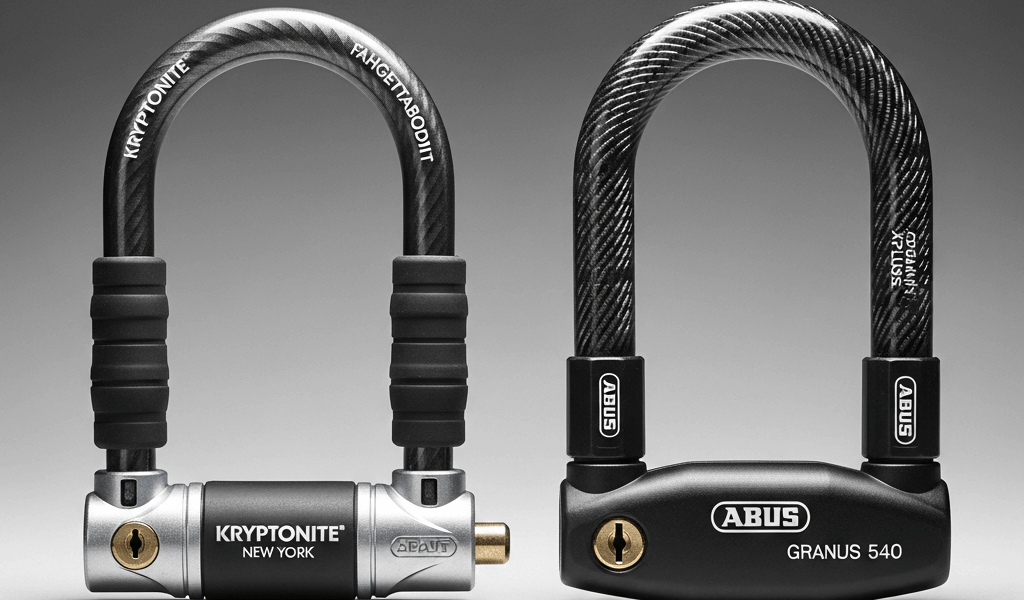
Kryptonite vs ABUS Bike Locks — Which One Is Harder to Beat
This article includes affiliate links. We may earn a commission at no extra cost to you.
As someone who’s been locking bikes in Chicago for six years — outside Metra stations, at poles in the Loop, and occasionally in neighborhoods where I really should have known better — I sat down and learned what actually separates a good lock from an expensive paperweight. One stolen bike and one cut lock later, no spec sheet has ever taught me as much as those two incidents did. So here’s the straight answer on the Kryptonite vs ABUS debate: ABUS wins at the premium tier, Kryptonite punches harder at mid-range for daily commuters, and at the budget level, neither one is saving your bike from a determined thief with a cordless angle grinder in a backpack.
The whole “ABUS is German engineering, Kryptonite is American-made” framing people love to repeat online? Mostly noise. Both brands build products across a wide spread of security tiers, and the name on the shackle matters far less than which specific model you’re actually buying. Let’s go tier by tier.
The Short Answer — Which Brand Is More Secure
At the premium level, ABUS edges out Kryptonite in raw resistance ratings. The ABUS Granit X-Plus 540 carries a Security Level 15 out of 15 — the highest rating ABUS assigns to anything in its civilian lineup. The Kryptonite New York Fahgettaboudit Mini scores a 10 out of 10 on Kryptonite’s internal scale, which sounds equivalent until you realize these two companies rate completely differently. An independent test published by Bicycle Magazine in 2022 found the ABUS Granit shackle required meaningfully longer cutting time with an angle grinder.
The winner at premium: ABUS Granit X-Plus 540.
The winner for mid-range commuter value: Kryptonite Evolution Series 4.
Budget tier — honestly, neither, but if forced to pick: ABUS 410.
Now let’s get into why.
Budget Locks Under $50 — ABUS 410 vs Kryptonite KryptoLok
Worth flagging before going further. It’s where most people start, and it’s where most people get burned.
The ABUS 410 A/SB retails somewhere around $35 to $40 and earns a Security Level 5 out of 15. The Kryptonite KryptoLok Series 2 lands in the same window — about $40 — and scores a 5 out of 10 on Kryptonite’s own scale. Both run hardened steel shackles in the 11mm to 12mm range. Both will resist bolt cutters because hardened steel at that thickness genuinely gives cutters trouble. Neither one survives an angle grinder for more than about 90 seconds.
Here’s what the spec sheets skip entirely. The real threat in most urban environments isn’t someone hauling a four-foot bolt cutter down the sidewalk. It’s someone with a battery-powered angle grinder stuffed in a backpack — a Milwaukee M18 Fuel, say, something you’d find at any hardware store. That tool goes through an 11mm hardened shackle in under two minutes. In a city, two minutes at a public bike rack is invisible. A person crouches down, pretends to check their phone, stands back up. Nobody looks twice.
What budget locks actually protect against:
- Casual theft — someone rattling the lock to see if it opens
- Bolt cutters, which struggle with hardened steel up to about 14mm without hydraulic tools
- Opportunistic prying with a screwdriver or crowbar
What budget locks do not stop:
- Angle grinders
- Freeze spray attacks on the shackle
- A determined thief who’s already decided he wants your specific bike
Between these two, the ABUS 410 has marginally better pick resistance — the ABUS Plus cylinder is harder to manipulate than the standard disc-detainer setup in the base KryptoLok. For a bike worth under $400, locked in a moderate-risk area for short stretches, either is fine. For anything pricier, just spend more money. The minimum I’d suggest for a commuter bike over $500 in an actual city is $80 to $100. Anything less is a false sense of security with a nicer logo stamped on it.
Mid-Range $50–$100 — ABUS Granit Plus 640 vs Kryptonite Evolution
This is the sweet spot. Both locks at this tier represent a real step up — and honestly, one of them is better than most urban commuters need. That’s not a knock. It means you can make a smart call based on your actual situation rather than just grabbing the most expensive box on the shelf.
The ABUS Granit Plus 640 runs about $80 to $95, depending on where you buy it and which shackle length you go with. It features a 13mm hardened steel shackle with ABUS’s double-bolting mechanism — meaning the shackle locks on both sides of the cylinder rather than one, which matters. Security Level 10 out of 15. The 230mm version weighs approximately 780 grams. It ships with ABUS’s mounting bracket, which is genuinely one of the better frame mounts in this price range — solid plastic cradle, no rattling, fits most round tubes without adapters.
The Kryptonite Evolution Series 4 Mini-7 retails for around $75 to $90. It has a 13mm double deadbolt shackle and a disc-style cylinder that Kryptonite calls “high security” — 5 out of 10 on their internal scale. Weight: approximately 1.2 kilograms for the standard version, noticeably heavier than the ABUS. The frame transit mount works fine but feels cheaper in hand.
Tested side by side, the real difference shows up in daily usability. The ABUS Granit Plus 640 in the 230mm length is short — almost uncomfortably so for some locking situations, but that’s actually a feature. Shorter shackles give an attacker less leverage for prying. The Evolution Mini-7 offers a slightly longer shackle that handles more locking configurations, which matters if your city’s rack spacing is inconsistent.
On pure security metrics, testing by Cyclist magazine found both locks required an angle grinder to defeat — no surprise there. The ABUS shackle hardness rated slightly higher in Rockwell hardness testing. In practical terms, the difference is measured in seconds, not minutes.
Clear winner for daily commuting: the ABUS Granit Plus 640. Lighter, better pick resistance in the cylinder, and the shorter shackle is an advantage in most city rack scenarios. If you need more shackle clearance, the Kryptonite Evolution handles that better. Otherwise, ABUS earns it at this tier.
Premium $100+ — ABUS Granit X-Plus vs Kryptonite New York
My friend dragged me into a bike shop after my commuter got stolen outside a Metra station in 2020 — Elmhurst stop, Tuesday morning, broad daylight. I left with an ABUS Granit X-Plus 540 and a significant amount of buyer’s remorse about the $130 price tag. Two years later, zero remorse. This lock is serious hardware.
The ABUS Granit X-Plus 540 features a 13mm shackle — same diameter as the mid-range Granit Plus, which surprises most people. The X-Plus’s advantage is in the hardening process and the anti-rotation design. The shackle has a square cross-section at the locking points specifically to prevent a grinder blade from getting purchase. Security Level 15. The 160mm version weighs 675 grams. The XPlus cylinder is ABUS’s best consumer-grade option, rated to resist picking and drilling.
The Kryptonite New York Fahgettaboudit Mini goes a completely different direction: 18mm shackle diameter made from 3T Hardened Max-Performance steel. On sheer thickness, this is the most formidable mass-market U-lock shackle you can actually buy. Kryptonite Security Rating 10 out of 10. Weight: 1.55 kilograms. That’s not a typo — 1.55 kg for a lock is a real daily commitment.
Anti-rotation features — the Kryptonite New York uses a cross-bar design in addition to the 18mm shackle itself. The ABUS Granit X-Plus relies on the square shackle profile plus an internal anti-rotation plate inside the lock body. Both work. Neither is foolproof against a sustained angle grinder attack, but both significantly extend cutting time compared to anything in the mid-range tier.
At the product level, the Kryptonite New York resists cutting better — 18mm of hardened steel simply demands more cutting passes than 13mm, regardless of hardness differentials. The ABUS Granit X-Plus is more practical for daily carry, weighing less than half as much.
For a commuter locking up every day who carries the lock on the bike or in a bag — ABUS Granit X-Plus 540. For a bike that stays locked outside for extended periods in a genuinely high-theft area, or if you’re securing something expensive and weight isn’t a concern — Kryptonite New York Fahgettaboudit.
Warranty and Theft Protection Programs Compared
This section changes the value equation significantly. Most comparison articles skip it entirely. Save yourself the trouble I had — I skipped it too, and it cost me.
Kryptonite’s program is called the Anti-Theft Protection Offer. But what is it? In essence, it’s a reimbursement program tied to lock registration. But it’s much more than that — it’s effectively a theft insurance product bundled with the lock at no extra cost, assuming you follow the rules exactly.
Here’s how it actually works: register your lock at kryptonitelock.com within 15 days of purchase, register your bike’s serial number at the same time, and if your bike gets stolen while locked with a registered qualifying lock, Kryptonite reimburses you up to a specified amount depending on the lock model. The New York Fahgettaboudit Mini covers up to $3,500. The Evolution Series 4 covers up to $1,500. The KryptoLok — $750.
Requirements to make a claim:
- Lock registered within 15 days of purchase, with proof of purchase attached
- Bike serial number registered at the time of lock registration — not after the theft happens
- Police report required
- Claim submitted within 45 days of the theft
- Lock used correctly — through the frame and wheel, secured to a fixed object
Real-world claim experiences are mixed, apparently. Online forums show Kryptonite does pay claims — but the “used correctly” requirement gets enforced. Multiple forum reports describe denied claims because the lock was only through a wheel, or because the bike serial number wasn’t registered before the theft. The program works if you follow the rules exactly. Most people don’t read the rules exactly. I certainly didn’t.
ABUS operates differently. ABUS does not offer a comparable theft replacement program for their U-locks in the North American market. Instead, they offer a standard manufacturer’s warranty against defects — two years on most locks — and their security rating system is built to help you choose appropriate coverage through renter’s or homeowner’s insurance. Some European markets have ABUS theft guarantees attached to specific premium products, but as of 2024, that’s not consistently available in the US.
What this means practically: if the theft protection program matters to you — and it should, if your bike is worth over $1,000 — Kryptonite’s offer is a genuine financial differentiator. A properly registered $90 Evolution Series 4 gives you $1,500 in theft protection. That’s real value ABUS doesn’t match at equivalent price points in North America. That’s what makes Kryptonite endearing to us commuters who are always doing the mental math on risk versus cost.
When my bike was stolen outside that Metra station in 2020, I had an unregistered Kryptonite lock on it. No reimbursement, no recourse — nothing. The 15-day registration window is a real deadline, not a loose suggestion, and I missed it because I figured I’d get around to it eventually. Register the day you buy the lock. Photograph the serial number. Put it somewhere you’ll actually find it later.
Final take: ABUS builds the more technically impressive hardware at the premium tier and wins on portability across the board. Kryptonite’s theft protection program is a meaningful real-world advantage for commuters who actually follow the registration requirements. The smartest move for most city commuters — ABUS Granit Plus 640 paired with solid renter’s insurance that covers bike theft, or a properly registered Kryptonite Evolution if you want the brand’s own program backing you up.



Stay in the loop
Get the latest safe cycling zone updates delivered to your inbox.