What Kind of Shifting Problem Do You Actually Have
Bike derailleur problems have changed quite a bit thanks to the conflicting advice flying around. Half the forums tell you to start with limit screws. The other half say cable tension fixes everything. Most riders I’ve talked to guess wrong on the first try — at least if my own experience is any measure — and waste thirty minutes making things worse.
Match your symptom below. Then skip straight to that section. Don’t touch anything else.
- Slow to shift up — Chain hesitates climbing toward the larger cog. Almost always cable tension. Start there.
- Won’t drop to the smallest cog — Derailleur stalls before swinging all the way inward. Suspect the low limit screw or a bent hanger — sometimes both.
- Skips gears randomly — Shifts fine most of the time, then struggles on one or two specific cogs. Cable fraying or damaged housing is usually doing this.
- Only misbehaves under load — Feels perfect standing still, falls apart when you’re actually pedaling hard. Cable tension or a worn cable. Classic.
- Grinding or rubbing sound — Chain rubs the derailleur cage on certain cogs. Points to limit screw misalignment or a hanger that took a hit.
You’ve got your diagnosis. Now go fix only what’s broken. So, without further ado, let’s dive in.
Cable Tension Is Wrong and How to Adjust It
As someone who spent years commuting by bike through Philadelphia winters, I sat down and learned cable tension the hard way — mostly by ignoring it too long and then panicking mid-commute on Broad Street. Today, I will share it all with you.
But what is cable tension, exactly? In essence, it’s how taut the derailleur cable is between the shifter and the derailleur body. But it’s much more than that. It’s the thing controlling how far and how fast the derailleur swings with every click. Too loose, and the derailleur doesn’t travel far enough. Too tight, and it overshoots. The fix lives in a small threaded collar called a barrel adjuster — no tools required.
Finding Your Barrel Adjuster
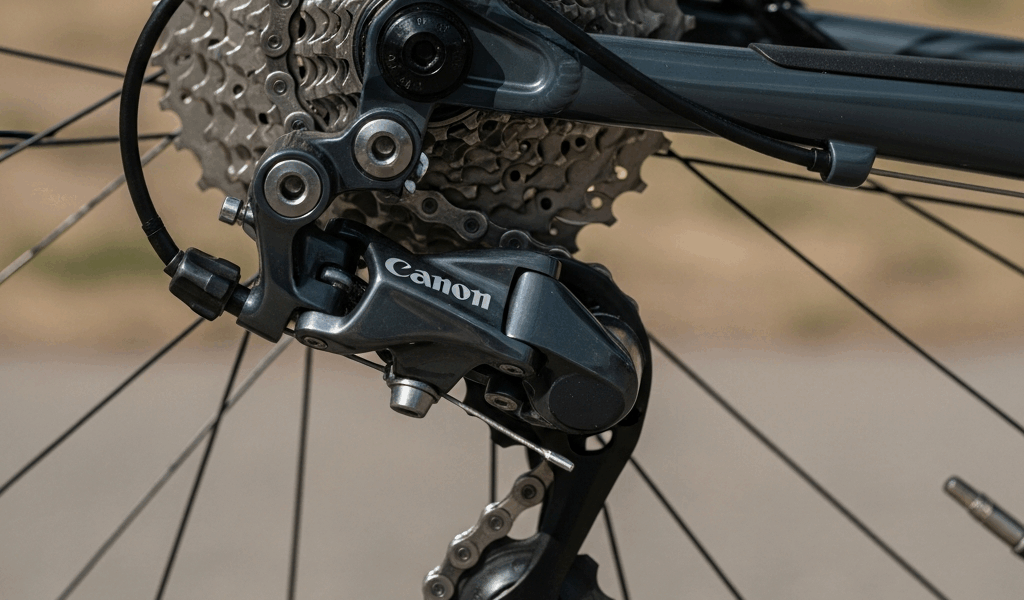
Look where the cable enters the derailleur. See a grooved, rotatable collar? That’s it. Some bikes put it on the frame instead — wherever the cable makes its first significant bend. Either location works identically. Some bikes have both. Lucky you.
The Half-Turn Method
Shift onto the middle cog. Pedal slowly with no real load on the drivetrain. Just listen.
Chain struggling to climb toward the largest cog? Cable’s too loose. Turn the barrel adjuster counterclockwise by half a turn. Wait three seconds. Try again.
Chain struggling to drop toward the smallest cog, or making noise doing it? Too tight. Turn clockwise by half a turn.
Half a turn at a time — that’s the whole method. Most fixes take two to four turns total. When shifting feels instant and quiet across every cog, you’re done. No hesitation. No chain noise. Just clean movement in both directions.
How to Confirm It Worked
Shift all the way to the largest cog. Then all the way to the smallest. Do it twice through. Smooth both directions? Done. One direction still sluggish? One more half-turn that way.
Quick note before the rest of this. I’ve been asked to diagnose shifting problems — online, at group rides, in parking lots — maybe two hundred times. Seventy percent of the time it’s just cable tension. People skip it because it feels too simple. Save yourself the trouble I had.
Limit Screws Are Off and How to Set Them
Cable tension didn’t fix it? Then you’re probably dealing with a limit screw. But what is a limit screw? In essence, it’s a mechanical stop — a small set screw that physically prevents the derailleur from swinging too far in either direction. But it’s much more than just a safety feature. Get these wrong and your chain ends up in the spokes or off the smallest cog entirely.
Every rear derailleur has two: H and L, stamped right on the body. H limits the outward swing toward the smallest cog. L limits the inward swing toward the largest.
Here’s the tell: Chain throwing itself off the cog and landing somewhere it shouldn’t? That’s a limit screw problem. No barrel adjuster in the world fixes that. Shifting slow but staying on the cogs? That’s cable tension — go back one section.
Setting the Low Limit (L Screw)
Shift to the largest cog. Get the wheel spinning freely — a repair stand helps, or flip the bike upside down. Look at the derailleur cage from directly behind. The inner plate should sit roughly 1.5 mm from the chain. Credit card thickness, if you need a reference.
Cage rubbing the chain? Turn the L screw clockwise. Gap wider than 2 mm? Turn counterclockwise. Quarter-turn at a time. Spin the wheel between each adjustment. This is not a process you want to rush.
Setting the High Limit (H Screw)
Shift to the smallest cog now. Outer derailleur plate should be about 1.5 mm from the chain — same standard, opposite side.
Clockwise moves the cage away. Counterclockwise brings it closer. I’m apparently heavy-handed with a screwdriver, and my first attempt on a vintage Shimano 105 back in 2009 sent the chain straight into the spokes. Ugly. Quarter-turns exist for a reason — at least if you want to skip that particular experience.
Once both screws are properly set, you’ll need to revisit cable tension. They interact. You’ll notice the difference immediately once both are dialed.
Bent Derailleur Hanger — How to Check and What to Do
A bent hanger is sneaky. Genuinely sneaky. It mimics cable tension problems, it mimics limit screw problems — it sends riders in circles for an hour before anyone thinks to check it. That’s what makes hanger bends so frustrating to us home mechanics who already spent forty-five minutes on the wrong fix.
The hanger is the small metal tab bolted to the dropout where the derailleur attaches. Deliberately engineered to be the weakest link — it bends so the derailleur survives impact. A crash, a pothole, one moment of leaning the bike carelessly against a car door. That’s all it takes.
The Visual Check
Shift to the smallest cog. Stand directly behind the bike. The derailleur cage should align perfectly with the cog — no tilt left or right. Any angle, and the hanger is bent.
Check from the side too. The derailleur should hang perpendicular to the ground. Leaning visibly forward or backward? Bent.
What to Do
Minor bends — under 2 mm — can sometimes be straightened with a hanger alignment tool. Park Tool makes a solid one, the DAG-2.2, somewhere around $75 to $90. Cheaper options exist for $25 to $40, though you’ll feel the difference in precision. Unless you’ve straightened hangers before, there’s a real chance you’ll overcorrect.
Severe bends need replacement. Hangers run $15 to $45 depending on the frame — they’re model-specific, so check your frame brand first. A shop can swap one in fifteen minutes, usually $20 to $30 in labor.
If your shifting went sideways after a crash or a pothole, check the hanger before touching anything else. No cable adjustment saves a bent hanger. Not even close.
When Cleaning or Replacing the Cable Actually Fixes It
Frayed cables and gummed-up housing are the quiet killers of smooth shifting. Most people jump straight to barrel adjusters without ever looking at the cable itself. I did this for embarrassingly long — probably two full years on one bike before a shop mechanic wordlessly pointed at the frayed end near my derailleur.
Look where the cable enters the housing. Rust. Kinked strands. Visible fraying. Any of those, and the cable is done. A frayed cable creates drag that no amount of barrel adjustment can compensate for — at least not for long.
Quick Cable Check
Shift to the middle cog. Find an exposed section of inner cable and gently squeeze it between two fingers. Move it. Does it slide freely? Or does it feel gritty, sticky, resistant? Gritty means the housing interior is full of dirt and corrosion. Not a great situation.
A light degreaser worked back and forth through the housing can sometimes buy another season. Sometimes. If the cable feels crunchy or looks visibly damaged, stop cleaning and start replacing.
Cable Replacement
Derailleur inner cables run $8 to $15. Compressionless housing costs roughly $2 to $5 per foot. A complete set — Jagwire and Shimano both make reliable options — comes out to $20 to $30 and takes about twenty minutes with a decent cable cutter and end cap crimper. The Park Tool CN-10 cable cutter runs about $35 and lasts forever.
I’m apparently hard on cables — commuting in rain and road salt will do that — and I replace mine every twelve to eighteen months. Dry climate riders can probably stretch to two years. New cables genuinely shift like magic. It’s one of those maintenance jobs that feels optional right up until you do it.
Start with the symptom list. Match it. Fix only what you know is broken. That’s the fastest path to smooth shifting — and the one that doesn’t cost you an extra hour of confusion.



Stay in the loop
Get the latest safe cycling zone updates delivered to your inbox.