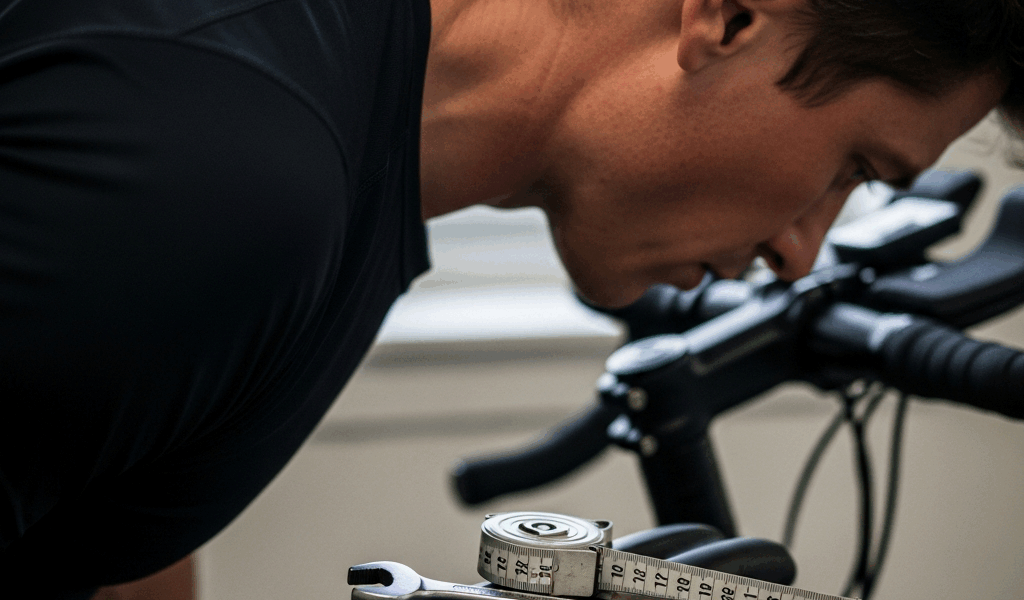
How to Tell If Your Handlebar Height Is Off
Bike fit has grown more complex with the conflicting advice flying around. I spent three full seasons riding with handlebars sitting about two inches too high — never once suspecting that was the problem. The symptoms were real enough: neck stiffness every Sunday evening, a dull ache creeping into my lower back somewhere around mile eight, fingers going numb on longer climbs. I swapped saddles twice. Bought new grips. Kept fiddling with seat height. Nothing worked. Turns out the culprit was right in front of me the whole time.
Steer clear of where I went wrong. Here’s what your body is actually telling you:
- Neck stiffness and upper back tension — Bars too high mean you’re sitting more upright, which forces your head and neck to crane backward. That tension builds quietly in your cervical spine over 45 minutes or so. You’ll know it the next morning — usually around 6 a.m. when you try to turn your head and can’t.
- Hand or wrist numbness — High bars push too much weight forward onto your hands and forearms. Cyclists call it “weight stacking.” It compresses the nerves running through your wrists and usually shows up as tingling in the fingers somewhere past the halfway point of a ride.
- Lower back pain — Sitting too upright shifts your weight onto your sit bones and pulls your core out of the equation. Your lower back muscles pick up the slack as stabilizers — work they weren’t designed to sustain for two hours. Starts as a dull ache. Gets sharper the harder you push.
- The constant “reaching” sensation — Bars too low create the opposite problem. You’re stretching forward constantly, shoulders bunching, forearms burning by mile five. This isn’t a flexibility issue. It’s a geometry mismatch.
- Feeling totally upright with no forward lean — If you look like you’re riding a beach cruiser but you’re on a performance road bike, your bars are almost certainly too high. Descents feel sketchy. Acceleration feels sluggish. Everything feels slightly wrong.
These symptoms point specifically to bar height because your saddle height and handlebar height work together — they’re what determine your reach and your spinal angle. A professional bike fitter can dial in both simultaneously, but most home adjustments start with the bars.
The Quick Way to Check Your Bar Height at Home
Worth mentioning before anything else. You need zero tools for the diagnostic part. Stand over your bike, one foot on the ground, and measure the distance from the top of your saddle to the top of your handlebar stem. Use a ruler, a tape measure — even a marked pen against the wall works fine.
Here’s the rough guide. For everyday comfort riding — commuting, social pace, all-day touring — your handlebars should sit roughly level with your saddle, or about an inch below. For road cycling or anything performance-focused, bars typically drop one to three inches below saddle height. Time trialists go lower still, but that’s a different conversation entirely.
There’s a second check you can do while sitting on the bike. Drop your arms to your sides with your elbows bent at roughly 90 degrees. Your elbows should line up with — or sit just behind — your hip bones. Elbows well in front of your hips? Bars are too low. Elbows well behind? Too high. Simple as that.
I measured my bars three separate times before I actually moved anything. Wanted to be completely sure I wasn’t just bad at cycling. Turns out I was both — bad at cycling and had my bars set wrong. Anyway.
These are starting points, not commandments. A gravel rider who needs to see what’s coming might want higher bars than a road racer. A rider with a long torso and shorter arms might prefer lower bars. The whole point is matching your geometry to how and where you ride.
How to Adjust a Threadless Stem
Most modern bikes — really anything built after roughly 2005 — use a threadless stem, sometimes called an ahead-set stem. This is almost certainly what you’re working with unless you’ve got a vintage road bike or an older city cruiser gathering dust.
But what is a threadless stem? In essence, it’s a stem that clamps around the outside of the fork’s steerer tube rather than threading into it. But it’s much more than that — the whole system uses stackable spacers to control height, which gives you surprisingly precise adjustment in 5mm increments.
While you won’t need a full toolbox, you will need a handful of hex keys — typically a 4mm, 5mm, and 6mm — and ideally a torque wrench if you have one sitting around.
Step 1: Loosen the top cap bolt. This is the single bolt sitting on the very top of the stem. It’s usually a 6mm hex. Turn it counterclockwise about two full turns — enough to free things up without pulling it out completely.
Step 2: Loosen the stem clamp bolts. These are the bolts on the face of the stem, pointing toward the front wheel. Usually 4mm or 5mm. Loosen all of them — typically two or four bolts — about three-quarters of a turn each. The bars should feel loose now. Not floppy, just free.
Step 3: Rearrange your spacers. Slide a spacer from below the stem to above it, or the other direction. A single 5mm spacer move changes your bar height by 5mm. Most setups use spacers in 5mm and 10mm heights — check yours before assuming. Moving one 10mm spacer from below to above the stem raises your bars a full centimeter.
Step 4: Retighten in the correct order. First, snug the top cap bolt by hand — you want gentle resistance, not a death grip. Then tighten the stem clamp bolts in an alternating pattern: top bolt, bottom bolt, repeat. This lets the stem clamp evenly without warping. If you have a torque wrench, aim for 5 Nm on the top cap and 5 to 6 Nm on the clamp bolts. No torque wrench? Snug it down, then add roughly a quarter turn more. Stop before it feels like you’re forcing it.
One thing that actually matters: your stem has a minimum insertion line engraved somewhere on the steerer tube section. That line exists for a reason. Never raise your bars high enough that the stem rides above it. The fork can fail if you do — and that’s not a gentle failure.
How to Adjust a Threaded Stem
Threaded stems show up on older road bikes, vintage mountain bikes, and a handful of city bikes. Mechanically simpler. Less precise. But genuinely easy to work with.
Look for a single bolt on top of the stem pointing straight up — usually a 6mm or 8mm hex, though older bikes sometimes use a 10mm. Turn it counterclockwise several turns until the stem feels loose. Then lift or lower the stem to your preferred height. There’s a maximum height line marked on the stem. Same rule applies here — don’t go above it.
Retighten clockwise until it’s firm. Don’t muscle it; threads on older stems strip more easily than you’d expect, and replacements for some vintage sizes are annoying to track down. That’s the whole process. No spacers, no sequencing, no drama.
The limitation is range — you’re typically looking at about two inches of total adjustment before you hit the maximum line. Most riders land in their sweet spot somewhere in there. If you need more range than that, a different stem length or a riser stem might be the actual solution.
How to Know When the Height Is Right
Take a test ride after adjusting — fifteen minutes around the block is genuinely enough to feel a meaningful change. Your elbows should have a slight, relaxed bend. Not locked straight. Not cranked up at 120 degrees. Shoulders down and away from your ears.
Look straight ahead without tilting your head up or tucking your chin down. Your hands should feel supported — not like they’re absorbing your entire upper body weight every time you hit a crack in the pavement.
Small moves feel bigger than they are at first. A 5mm shift changes your weight distribution, your spinal angle, your leg drive through the pedal stroke. Give it three or four rides before deciding anything definitive. Muscle memory takes time to catch up with physical reality.
If the neck pain, numbness, or back ache is still there after adjusting the bars and giving yourself a week or two to adapt — book a session with a professional bike fitter. The actual problem might be saddle height, overall reach, cleat position, or something about your individual geometry that needs a trained eye. That’s what makes professional fitting endearing to us obsessive cyclists — it accounts for all the things a hex key and a ruler can’t.




Stay in the loop
Get the latest safe cycling zone updates delivered to your inbox.