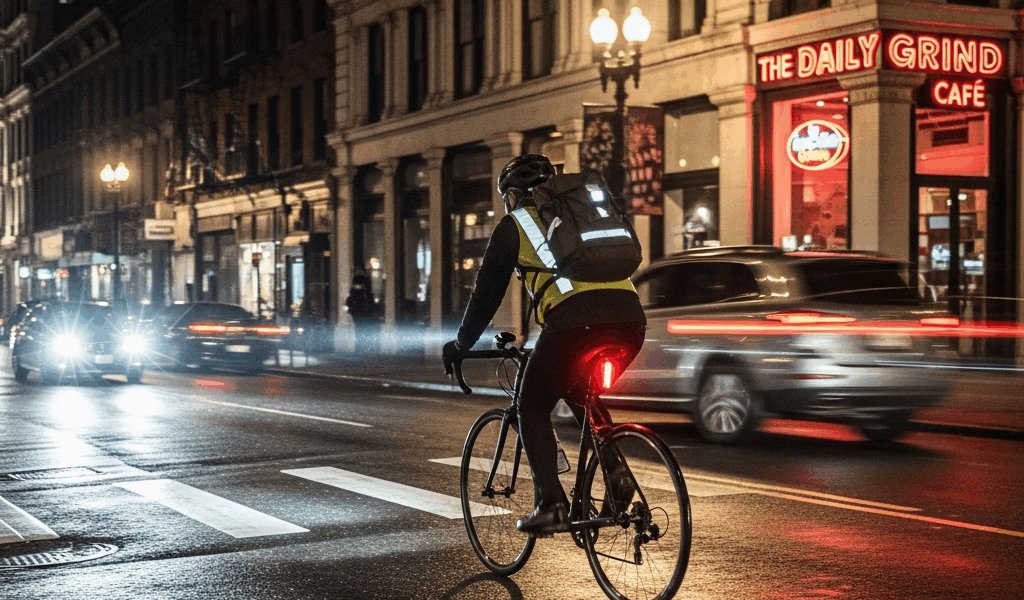
You are riding home from work in November and the sun set 45 minutes ago. You have a front light, maybe a rear blinker, and you are hoping that is enough. Here is the honest truth: most cyclists dramatically underestimate how invisible they are to drivers at night, and the gap between “having a light” and “being genuinely visible” is where most nighttime cycling incidents happen.
This article includes affiliate links. We may earn a commission at no extra cost to you.
Why Drivers Cannot See You (Even With Lights)
A single front light and rear blinker meet the legal minimum in most states. They do not meet the practical minimum for being seen. Drivers process an enormous amount of visual information at night — headlights, taillights, street signs, traffic signals, pedestrians — and a single small blinking light on a cyclist registers as background noise, not a hazard to avoid.
The problem compounds at intersections, which is where the majority of car-cyclist collisions happen. A driver turning left scans for headlights at car height. Your front light is three feet lower and significantly dimmer than the weakest car headlight. Side visibility is even worse — most cyclists have zero lateral illumination, making them effectively invisible to cars approaching from cross streets.
Rain, fog, and wet roads make everything harder. Water on the road surface reflects light unpredictably, and drivers’ depth perception deteriorates. Your 200-lumen front light that looks adequate on a dry evening becomes a faint smear of light on a rainy one.
The Visibility System That Actually Works
Think of night visibility as a system, not a single product. You need to be seen from the front, rear, and sides, by drivers who are paying attention and by drivers who are not.
Front light: 400 lumens minimum for urban riding, 800+ for unlit roads. The Cygolite Metro 800 delivers 800 lumens in a compact, USB-rechargeable package with multiple modes including a steady pulse. Mount at handlebar height and aim slightly downward — blinding oncoming traffic creates its own danger.
Rear light: This is the single most important safety light on your bike. Drivers approach from behind with the least reaction time and the highest speed differential. A 100+ lumen rear light in dayflash mode is visible for over a mile on a straight road. Mount on the seatpost, not the saddle bag. Specific recommendation: the Cygolite Hotshot Pro 200 or the Light & Motion Viz 180 — both throw light in a wide arc, not just straight back.
Side visibility: The gap most cyclists ignore entirely. Spoke lights, reflective sidewall tires, or wheel-mounted LED strips solve this. When a car approaches from a cross street at night, your front and rear lights are invisible — they point forward and backward. Side illumination is what makes you visible at the intersections where most accidents occur.
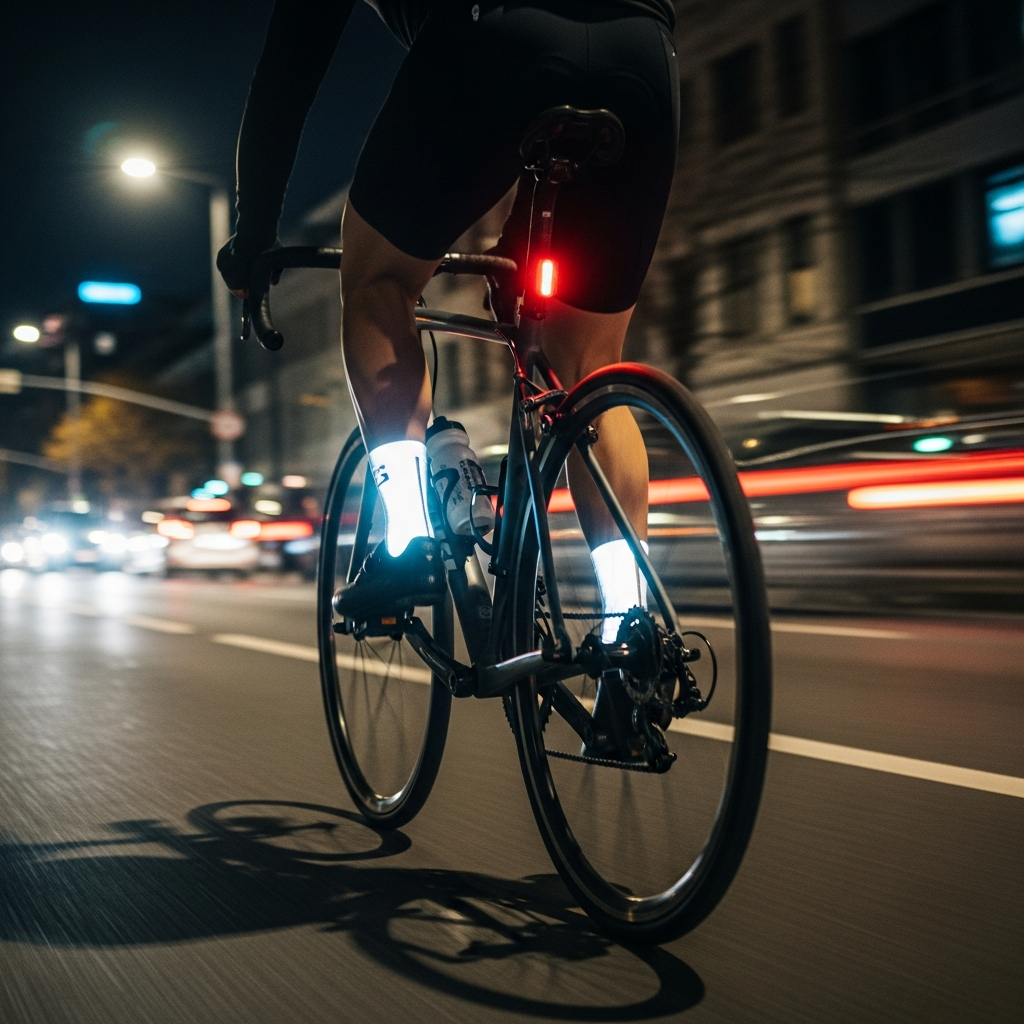
Reflective gear: Reflective ankle straps are disproportionately effective because the pedaling motion creates a recognizable up-and-down pattern that drivers’ brains register as “cyclist” instantly. A Proviz REFLECT360 cycling jacket is good. Reflective ankle straps plus a jacket is significantly better — the movement catches the eye.
Common Mistakes That Reduce Your Visibility
Running lights on full flash mode seems like the visible choice. It is not. Rapid strobe makes it nearly impossible for drivers to judge your distance and approach speed. Many drivers report that rapid-flashing bike lights are disorienting — they notice the light but cannot tell if you are 100 feet away or 30. A steady beam with a subtle pulse gives drivers the distance and speed cues they need to pass safely.
Dark clothing with a single light is a common setup and a poor one. The light gives drivers a point source with no context. They see a dot of light but cannot see the rider, the bike, or the space you occupy on the road. Reflective elements on your torso and legs give the light something to illuminate, creating a visible silhouette that registers as a human on a bike rather than a mystery light floating at knee height.
Helmet-mounted lights as your only front light create a hazard. They point wherever your head points, which means oncoming drivers get a face full of 400 lumens when you glance left. Use a helmet light as a secondary directional light for checking road surfaces and reading signs, not as your primary forward illumination.
The Minimum Night Commuting Kit
For under $100, you can build a visibility setup that genuinely protects you. Front light with 400+ lumens and a steady-pulse mode. Rear light with 100+ lumens and wide-angle projection. A set of reflective ankle straps. A reflective vest or jacket with reflective panels on the back and shoulders. Total cost for quality options: $60 to $100. Total weight added to your commute: under 200 grams.
That is not a lot of money or weight compared to the alternative. Charge your lights after every other ride, replace batteries in reflective accessories seasonally, and check that everything is working before you roll out the door. Being seen is not optional equipment — it is the single most important safety measure for anyone riding after dark.



Stay in the loop
Get the latest safe cycling zone updates delivered to your inbox.