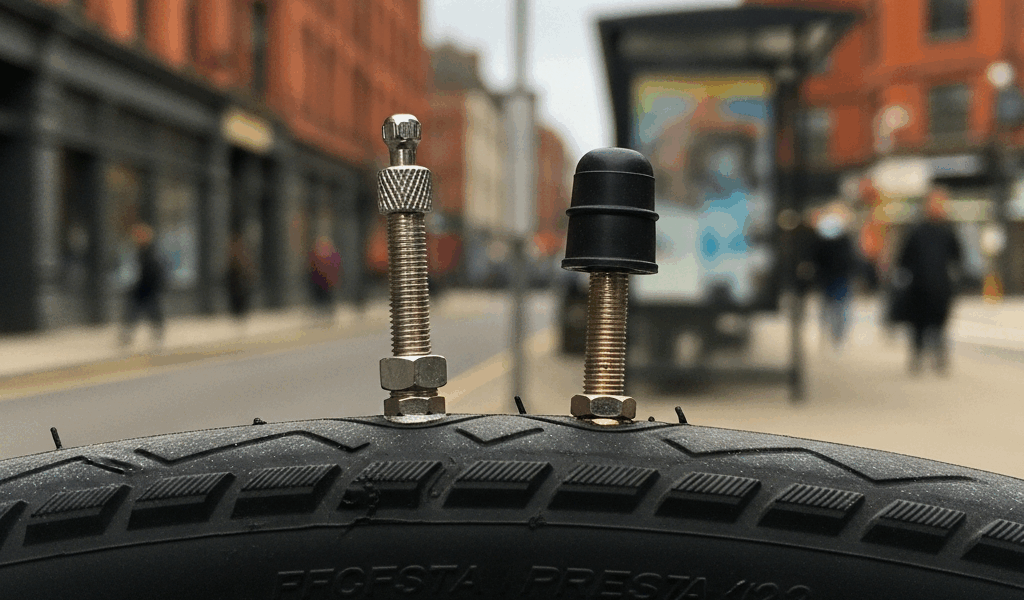
You just got a flat on your commute and pulled up to a gas station, air hose in hand, only to discover the nozzle does not fit your valve. You are looking at a Presta valve — the narrow one with the tiny locknut on top — and the gas station pump wants a Schrader, which is the fat valve on every car tire. This is one of those things nobody tells you about before your first commute, and it leaves you stranded if you do not plan for it.
Presta vs Schrader: The Quick Version for Commuters
Presta valves are narrow — about 6mm across — with a small threaded tip and a locknut you unscrew before adding air. Most road bikes, gravel bikes, and higher-end commuters use them. They hold pressure well at the high PSI road tires need, but they require a compatible pump head.
Schrader valves are wider — about 8mm — with a spring-loaded pin in the center. Same as your car tire. They work at any gas station, any auto shop, any friend’s tire inflator. Most hybrid bikes, city bikes, and entry-level commuters run Schrader. Universal compatibility is their biggest advantage for commuters who want to know they can inflate anywhere.
Check which valve you have right now, before you need to know in an emergency. Pop the valve cap off either wheel — if it is skinny with a tiny nut, that is Presta. If it looks like a miniature version of a car tire valve, that is Schrader.
The Gas Station Emergency: What Every Commuter Should Know
If your commuter bike runs Schrader valves, you are covered at any gas station air pump. Pull up, attach the nozzle, inflate to the PSI printed on your tire sidewall, and ride on. The universal compatibility is one of Schrader’s genuine advantages for daily riders.
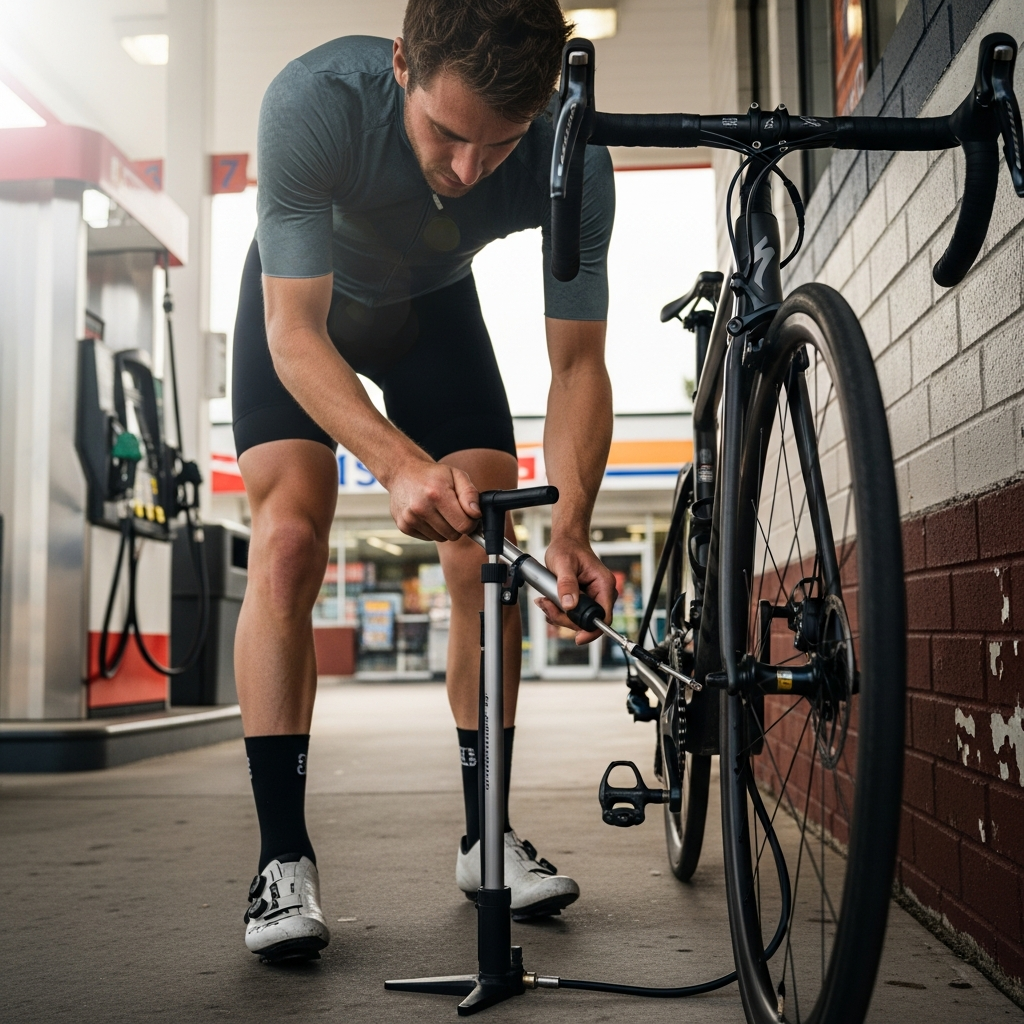
If your bike has Presta valves — which most road-style commuters do — a gas station air pump will not fit without a Presta-to-Schrader adapter. This is a small brass cylinder, roughly the size of a pencil eraser, that threads onto the Presta valve and converts it to Schrader dimensions. They cost $2 to $5 at any bike shop. Buy two: one for your saddle bag or commuter pack, one for a drawer at home.
I keep one in my commuter bag permanently. It weighs nothing and it has saved me twice — once when a slow leak turned into a genuine flat three miles from home and the nearest bike shop was closed. The gas station across the street had air. That $3 adapter turned a 45-minute walk into a 2-minute stop.
Which Pump to Carry for Commuting
For daily commuting, you want two inflation tools: a floor pump at home for regular pressure checks and a portable option in your bag for emergencies.
Most quality mini pumps and frame pumps made in the last several years handle both Presta and Schrader — but verify before buying. A dual-head pump means you never need to think about valve compatibility. Topeak, Lezyne, and Bontrager all make compact commuter pumps that fit both valve types. The Topeak Road Morph is my go-to recommendation — it has a small foot peg that lets you pump like a floor pump, which makes hitting 80+ PSI on a road tire actually achievable with a mini pump.
CO2 inflators are fast and compact but single-use per cartridge. If you miss or the seal fails, that cartridge is gone and you are walking. For commuting, I prefer a mini pump as the primary tool with a CO2 inflator as backup if weight matters. Never rely solely on CO2 for daily riding — the one time you need a second shot is the time you do not have one.
At home, a quality floor pump with a dual-head is the one purchase that eliminates valve confusion permanently. Check tire pressure before every commute — it takes 30 seconds and prevents the slow leaks that turn into mid-commute flats.
Identifying Your Valve Type in 10 Seconds
Remove the valve cap and look at the stem. Presta: narrow, about 6mm diameter, with a small threaded tip and a locknut at the top that you unscrew counterclockwise before inflating. Schrader: wider, about 8mm diameter, with a visible spring-loaded pin in the center — identical to a car tire valve.
Most city bikes and hybrids ship with Schrader valves for universal compatibility. Road-style commuters, gravel bikes, and performance hybrids typically run Presta. If you bought your bike at a shop, they can tell you in seconds. If you bought online, the valve type is usually listed in the wheel or tube specifications.
Know your valve before your first commute. Carry the right adapter if you run Presta. It is the smallest, cheapest piece of emergency kit that makes the biggest difference when a ride goes sideways.



Stay in the loop
Get the latest safe cycling zone updates delivered to your inbox.