MIPS vs WaveCel Bike Helmets — Which Is Actually Safer?
The MIPS vs WaveCel bike helmet debate has been running hot in cycling circles since Bontrager dropped its WaveCel line in 2019 with some genuinely bold safety claims. I’ve spent the last two years digging into helmet certification data, Virginia Tech’s independent STAR ratings, and peer-reviewed concussion biomechanics research — partly out of professional curiosity, and partly because I crashed at 22 mph on a gravel descent outside Charlottesville and walked away wondering whether my helmet had actually done everything it could for me. It had MIPS. I’m fine. But the question stuck.
So here’s what I found. Not a “both are great in different ways” non-answer. An actual verdict, with numbers behind it.
How Each Technology Works — In Plain English
Standard foam helmets — expanded polystyrene (EPS), the white crumbly stuff — work by compressing on impact and absorbing energy that would otherwise travel into your skull. They’re good at handling direct, linear hits. The problem is that most real-world cycling crashes don’t produce clean, linear impacts. They produce oblique ones, where your helmeted head strikes the pavement at an angle and rotates.
Rotational acceleration is the mechanism behind the majority of serious brain injuries. Concussions, subdural hematomas, diffuse axonal injury — these happen when brain tissue shears because the skull changes velocity faster than the tissue inside can follow. Standard EPS foam does almost nothing to address this.
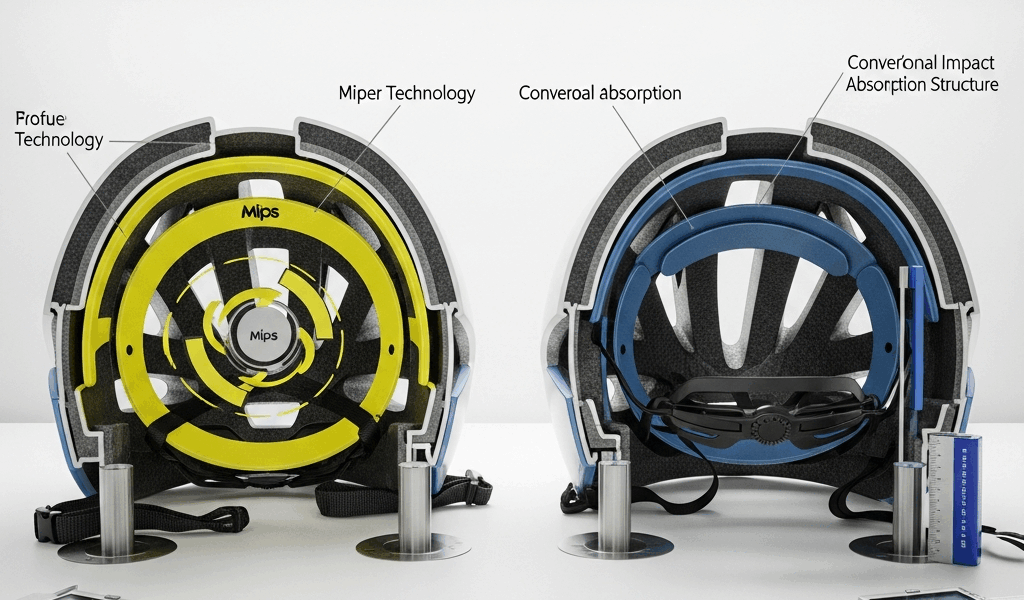
MIPS — The Slip Layer
MIPS stands for Multi-directional Impact Protection System. The Swedish company that developed it, founded in 1996 by neuroscientist Hans von Holst and engineer Peter Halldin, solved the rotation problem with elegant simplicity: a thin yellow plastic layer sits between your head and the helmet’s interior padding. On oblique impact, that layer slips 10–15mm, redirecting rotational energy away from your brain. It adds roughly 6–10mm to the helmet’s interior depth and, depending on the manufacturer, somewhere between $20 and $50 to the retail price.
MIPS licenses its system to nearly every major helmet brand — Giro, Bell, Specialized, Smith, POC, Lazer, Kali, Scott. The list is long. That licensing breadth is actually important, and I’ll come back to it.
WaveCel — The Crumple Zone
WaveCel is a completely different approach. Instead of a slip layer, it replaces part of the foam structure with a cellular material — think of a flexible, accordion-like lattice made from thermoplastic. On impact, the WaveCel cells flex, crumple, and then glide, addressing both linear and rotational forces through structural deformation rather than a separate mechanism.
Bontrager (Trek’s in-house brand) is the exclusive manufacturer of WaveCel helmets. That’s not a minor footnote — it means your helmet choices are limited to whatever Bontrager makes. As of 2024, that’s primarily the Specter WaveCel, the Blaze WaveCel, and a few others in the road and commuter segments.
SPIN — Skip This One
POC introduced SPIN (Shearing Pads INside) as a silicone pad system meant to function similarly to MIPS. In 2021, MIPS successfully sued POC for patent infringement in a Swedish court. SPIN has been quietly phased out of POC’s lineup. If you’re shopping an older POC helmet with SPIN technology, don’t factor that in as a meaningful differentiator. Stick with their newer MIPS-equipped models instead.
Virginia Tech Test Results — What the Numbers Say
Virginia Tech’s Helmet Lab runs the most credible independent helmet safety ratings available to consumers. Their STAR methodology — which stands for Summation of Tests for the Assessment of Risk — runs helmets through a matrix of impact locations and velocities, measuring linear and rotational acceleration. The resulting score predicts concussion risk relative to an unhelmeted head, and helmets earn a 1–5 star rating. Five stars is the best.
Probably should have opened with this section, honestly, because the numbers cut through a lot of marketing noise.
Top Performers — MIPS Helmets
- Giro Aether MIPS — 5 stars, STAR score 10.7 (lower is better)
- Smith Forefront 2 MIPS — 5 stars
- Bell Super Air R MIPS — 5 stars
- Specialized Propero 4 MIPS — 5 stars
- Giro Register MIPS — 4 stars (budget pick, ~$65)
Top Performers — WaveCel Helmets
- Bontrager Specter WaveCel — 5 stars
- Bontrager Blaze WaveCel — 5 stars
- Bontrager Rally WaveCel — 4 stars
Both technologies land in the 4–5 star range when implemented well. Virginia Tech’s data doesn’t declare a winner between MIPS and WaveCel at the category level — high-quality helmets from both camps outperform mediocre helmets from either. What the data does confirm is that both technologies measurably outperform standard EPS-only helmets, which cluster in the 1–3 star range.
One detail worth flagging: Virginia Tech periodically updates its ratings as it refines methodology. Scores from 2019 and scores from 2023 for the same helmet model can differ. Always check the current rating on their website (helmet.beam.vt.edu) rather than relying on older articles, including this one, for specific numerical scores.
Real-World Crash Protection Differences
Here’s where the technical distinction between the two systems starts to matter in practice. MIPS and WaveCel are solving overlapping but not identical problems.
MIPS is specifically and narrowly optimized for rotational energy management. The slip layer triggers on oblique impacts and decouples the helmet shell from your head. It does not meaningfully change how the helmet handles direct linear impacts — the EPS foam still handles that part exactly as it would without MIPS. The slip layer adds a rotational safety margin on top of whatever the foam already provides.
WaveCel’s cellular structure addresses both linear and rotational forces simultaneously through a single material system. In Bontrager’s own testing (yes, they funded it, which I’ll acknowledge), WaveCel outperformed MIPS helmets by a significant margin in oblique impact scenarios. Independent researchers have been more cautious about endorsing those specific claims, noting that the comparison used specific MIPS helmet models that may not represent the technology’s ceiling.
Dr. Michael Bottlang, a biomedical engineer whose research has been cited in Triathlete magazine and elsewhere, has noted that in crash reconstructions involving cyclists, oblique impacts at shallow angles — the kind where you’re sliding along pavement — are the dominant injury mechanism. Both technologies address this. The craniofacial trauma perspective, cited from surgeons who reconstruct facial and skull injuries post-crash, emphasizes that no helmet technology prevents all injury in high-speed impacts. What changes is the threshold at which serious brain injury occurs.
My own crash, for what it’s worth, was a classic oblique impact — front wheel washed out on loose gravel, I went down on my right side, helmet contacted the road at roughly a 30-degree angle while I was still moving forward. The MIPS layer did exactly what it’s designed to do. I had road rash. I did not have a concussion. Causality is hard to prove in a sample size of one, but I’m not skeptical of the mechanism.
Where WaveCel has a potential structural advantage is in repeated lower-velocity impacts or scenarios involving complex, multi-directional forces. Commuting in urban environments — where a crash might involve a car door, a curb, and then pavement in rapid succession — might theoretically benefit from a material system that manages multiple force vectors simultaneously rather than relying on a single-axis slip mechanism.
The Price Gap Is Closing — Cost Comparison
When WaveCel launched in 2019, the premium over comparable MIPS helmets was significant. The Bontrager Specter WaveCel debuted at around $150, while the MIPS premium on similarly positioned helmets was running $20–40 above the non-MIPS version of the same model.
In 2024, the gap has narrowed considerably. Here’s a realistic current price comparison across similar categories:
Road/Commuter Helmets
- Bontrager Specter WaveCel — $149.99 (5 stars, Virginia Tech)
- Giro Syntax MIPS — $159.95 (5 stars)
- Bell Formula MIPS — $79.99 (4 stars)
- Bontrager Rally WaveCel — $79.99 (4 stars)
Mountain/Trail Helmets
- Bontrager Blaze WaveCel — $199.99 (5 stars)
- Bell Super Air R MIPS — $249.95 (5 stars)
- Smith Forefront 2 MIPS — $220.00 (5 stars)
At the entry level, $79.99 gets you a 4-star helmet from either camp. At mid-range, WaveCel helmets are actually slightly cheaper than the top-tier MIPS competitors. Where MIPS wins on price is selection — because the technology licenses to dozens of brands, you can find MIPS helmets from $65 (Giro Register MIPS) to $350+. WaveCel’s exclusivity to Bontrager caps your options and means limited sales competition to drive prices down.
One mistake I made early in this research was assuming WaveCel must be better because it was more expensive when it launched. Price tells you almost nothing about protection quality in the helmet market. A $65 Giro Register MIPS earns 4 stars. A $280 non-MIPS aero helmet from a major brand earned 1 star in the same rating period. Buy based on ratings, not retail price.
Our Verdict — Which Helmet Should You Buy?
Driven by two years of reading crash biomechanics literature and staring at Virginia Tech spreadsheets, I’ll give you the direct answer the helmet marketing pages won’t.
For most cyclists — commuters, recreational road riders, gravel riders — buy a 4 or 5-star MIPS helmet. The protection is proven, the selection is massive, and you can find a well-rated option at nearly any price point above $60. The Giro Register MIPS at $65 and the Giro Syntax MIPS at around $160 are the two I’d point most people toward first, depending on budget. Both have Virginia Tech ratings that beat the majority of helmets on the market.
If you ride Trek or Bontrager exclusively, or you specifically want the WaveCel structural approach, the Specter WaveCel at $149.99 is an excellent helmet. Five stars. Solid fit system. If it fits your head well and you can get it at your local Trek dealer, there’s no reason not to buy it. The limitation is simply that you’re choosing within a single brand’s ecosystem.
SPIN — don’t bother. The technology is being discontinued, the patent litigation is settled, and POC has moved on. If you want a POC helmet, buy one with MIPS. The Omne Air MIPS and Ventral Air MIPS are both strong performers.
The broader point: the most dangerous helmet is a poorly rated one you chose because it looked fast, cost $300, and had a famous rider’s name on the marketing materials. Technology branding — MIPS logo, WaveCel logo — matters less than whether the specific model you’re buying tested well at Virginia Tech. Check the rating. Buy accordingly. Then go ride.



Stay in the loop
Get the latest safe cycling zone updates delivered to your inbox.