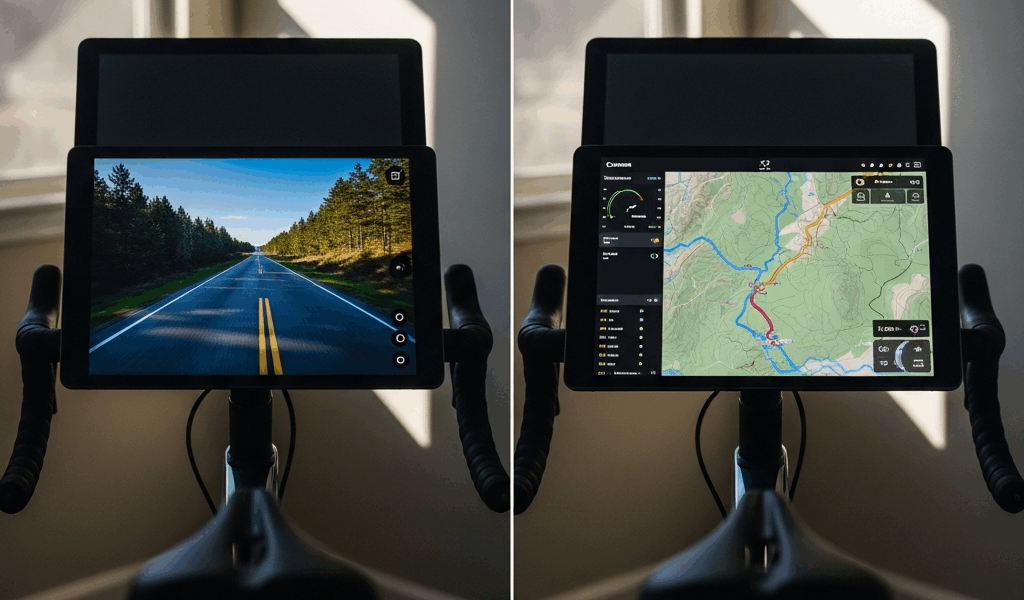
The Short Answer — One App Wins for Most Riders
The Kinomap vs Rouvy debate has gotten complicated with all the half-measured comparison posts flying around. So here’s what you actually came for: Rouvy wins for cyclists who want immersive, gradient-accurate rides on real-world routes. Kinomap wins for anyone weaving indoor cycling into a broader fitness routine. Two sentences. Done. Everything below explains the reasoning — plus a third verdict for budget-constrained riders that neither app’s marketing will bother telling you.
Most comparisons can’t pick a side because they treat these two platforms as direct competitors. They’re really not. Rouvy is a dedicated cycling simulator — AR-overlaid video, smart trainer resistance sync, the whole deal. Kinomap is a fitness platform that happens to include cycling routes, alongside rowing content, running videos, and live instructor-led sessions. That architectural difference is the whole ballgame. See them that way and the choice gets obvious fast.
Route Libraries and Video Quality
Rouvy has 13,000+ routes with AR overlay technology. Kinomap has 200,000+ videos. On paper, Kinomap wins by a factor of fifteen. In practice, that comparison is almost meaningless.
Kinomap’s library is community-uploaded. That means sifting through shaky helmet-cam footage, inconsistent lighting, random road noise, and routes filmed on someone’s phone in 2016. I spent about forty minutes one evening hunting for a usable Dolomites climb on Kinomap — gave up after three videos that were either too dark to watch or shot at some weird angle that made the road look like it was tilting sideways. Quantity is not quality here. Not even close.
Rouvy’s 13,000 routes are professionally filmed and calibrated. Gradient data syncs to the video, so footage speed actually adjusts to match your real pace. Slow down on a 9% grade and the video slows with you. That detail sounds minor until you’ve ridden a platform where it doesn’t work that way — the disconnect kills any sense of immersion entirely.
Rouvy also licenses official race routes. Tour de France stages, Strade Bianche, UCI World Championship courses. If riding Alpe d’Huez at 3 a.m. in your garage is something you’ve thought about — and if you’re reading this, it probably is — Rouvy is the only platform doing this at scale with proper production quality. That’s what makes it so endearing to us road cyclists. Kinomap simply can’t match it.
Smart Trainer Compatibility and Resistance Control
Probably should have opened with this section, honestly. It’s where the real decision lives for most people.
Both apps support ANT+ and Bluetooth. Both work with the major smart trainer brands — Wahoo KICKR, Tacx NEO, Elite Direto, Saris H3. Compatibility is essentially a wash on paper. Where they diverge is how tightly resistance simulation is integrated into the actual riding experience.
Rouvy’s gradient sync is precise. Hit a 12% ramp on a Tour de France stage and the trainer responds quickly, accurately, in a way that matches what you see on screen. On Kinomap, user reports — and my own testing on an Elite Zumo — consistently describe resistance changes that feel slightly delayed on grades above 8%. Not broken. Just less convincing.
Here’s the practical rule: if you own a mid-range smart trainer — anything in the $400–$700 range like a Wahoo KICKR Core or a Tacx Flux S — Rouvy’s gradient simulation is going to feel noticeably more accurate. If you’re on a basic wheel-on trainer, or running a speed/cadence sensor without resistance control, this entire distinction evaporates. Neither app can control resistance you don’t have. Rouvy’s main advantage disappears, and Kinomap’s broader content library becomes the more relevant factor. Don’t make my mistake of paying for precision features on hardware that can’t use them.
Pricing — What You Actually Pay Per Month
Do the math. As of 2024:
- Rouvy — $14.99/month, or $119.99/year (roughly $10/month annualized)
- Kinomap — $12.99/month, or $99.99/year (roughly $8.33/month annualized)
The annual difference is about $20. One mid-quality energy gel per month. It is not the deciding factor for anyone who owns a smart trainer and is genuinely committed to indoor training. I’m apparently someone who learned this the hard way — chose a platform based on the cheaper monthly rate, switched six weeks in anyway, and ended up paying for two subscriptions in the same quarter. The $1.67/month gap cost me more by trying to save it.
What the pricing actually reflects is product philosophy. Kinomap’s lower cost matches its broader, shallower feature set — a general fitness platform with cycling as one lane. Rouvy’s slightly higher price covers a purpose-built cycling simulator with production-quality content and tighter trainer integration. Neither is overpriced for what it delivers.
Both offer free trials — Rouvy gives you 14 days, Kinomap gives you 7. Verify current pricing directly on their sites before subscribing. Subscription costs shift, and what’s accurate here may not match what you see when you actually sign up.
Which App to Choose Based on How You Actually Train
Three verdicts. No hedging. So, without further ado, let’s dive in.
Road Cyclist With a Smart Trainer
Choose Rouvy. Full stop. The AR overlay, the gradient sync, the real-world race routes — this is what the platform was built for, and it executes on all of it. If riding famous climbs with accurate resistance is the whole point of your indoor setup, there is no version of this decision where Kinomap makes more sense. None.
Cross-Trainer or Multi-Sport Fitness Rider
Choose Kinomap. Your week includes rowing sessions, treadmill runs, and cycling — and you want one app to cover it. Kinomap is the only one of these two that actually works across disciplines. Rouvy is cycling-only, full stop. Kinomap covers the full spectrum with live instructor content and community classes layered on top of video routes. For this rider, Rouvy is a solution to a problem they simply don’t have.
Cyclist on a Tight Budget With a Basic Trainer
Kinomap wins on value here. Rouvy’s two core advantages — AR overlay and resistance simulation — only matter if you have a smart trainer capable of using them. Running Rouvy on a dumb trainer means paying a premium for features you can’t actually access. Kinomap’s content variety is more useful in that situation, and the lower price reflects that it’s genuinely the right tool for the job.
The one scenario where trying both makes sense: you’re deciding between a dedicated cycling platform and a general fitness app, and you own a smart trainer. Do the 14-day Rouvy trial on your actual setup. Ride two or three routes that matter to you — a real climb, a race stage, something with varied gradient. If the immersion lands, the $20/year premium is an easy call. If it doesn’t move you, Kinomap’s variety at a lower price is genuinely the better fit. The trial will tell you more than any comparison article can — including this one.




Stay in the loop
Get the latest safe cycling zone updates delivered to your inbox.