Why Your Brakes Are Squealing in the First Place
Bike brake squealing has gotten complicated with all the bad advice flying around. Sand the pads. Adjust the cable. Buy new brakes. I spent three years on a hybrid with disc brakes that screamed like a dying bird — a Specialized Sirrus, nothing fancy — before I stopped guessing and actually diagnosed what was wrong. That was 2019. I haven’t had a squealing brake since.
Today, I will share it all with you.
The noise almost always traces back to one of three things. Glazed pads or rotors — friction surfaces that have gone shiny and hard instead of grippy, usually from heat buildup or just age. Contamination — chain oil, hand grease, or even water sitting between the pad and the braking surface. Or misalignment — the pad isn’t hitting square, or the caliper has drifted off-center. That’s it. Three culprits.
Before you touch anything, answer two questions: rim brakes or disc brakes? And does the squeal happen constantly, only when wet, or only after the bike has been sitting unused? Your answers determine which section below actually applies to you. Skip the rest — seriously, don’t read what doesn’t apply to you.
How to Fix Squealing Rim Brakes
Rim brakes are mechanically simple — which is mostly good news. The fixes are usually quick. But contamination hits harder here because there’s nowhere for gunk to hide from the friction surface.
Step 1: Clean the rim. Grab a rag and some isopropyl alcohol — 70% concentration from any drugstore, roughly $2 a bottle. Wipe down both braking sides of the rim. Chain lube buildup is the culprit most riders miss entirely, and I was one of them. I once spent an hour fussing with toe-in adjustments when a five-minute cleaning would have solved everything. Don’t make my mistake.
Step 2: Inspect your pads. Look at the friction surface up close. Shiny and smooth, almost like plastic? That’s glazing. Dull with a bit of texture? Probably fine. Glazed pads need light sanding — 80-grit sandpaper, maybe two minutes per pad, just enough to rough the surface back up. Or replace them outright if they’re thin. Under 1mm of material left means they’re done regardless of glazing.
Step 3: Set the toe-in. This is the real fix most people skip. The front edge of each pad should make contact with the rim a hair before the rear edge does — about a business card’s worth of difference. When pads hit flat or rear-first, they chatter. They squeal. Most rim brake calipers have a small barrel adjuster on the cable housing. Loosen it a quarter turn, squeeze the lever, check the contact pattern, adjust again. It takes patience. It works.
Clean rim, roughed-up pads, proper toe-in — that combination kills rim brake squeal in probably 90% of cases. If it doesn’t work, the pads are past saving. Move to the replacement section.
How to Fix Squealing Disc Brakes
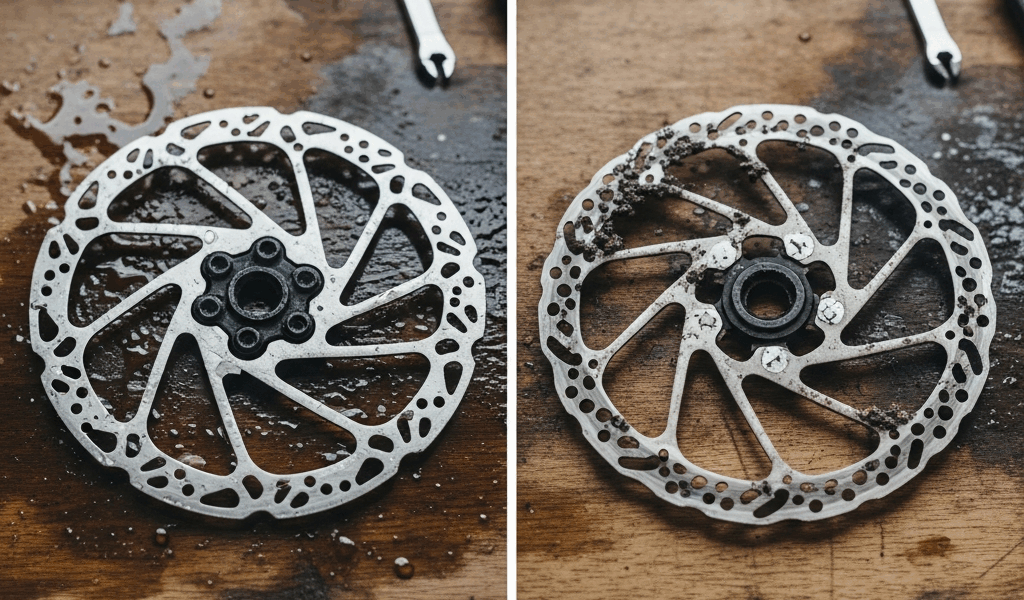
Disc brake squeal is louder and more obnoxious than rim brake squeal, partly because the rotor itself acts like an amplifier. A 160mm rotor vibrating at the right frequency is genuinely unpleasant. The good news is that most cases are fixable at home without special tools.
Scenario 1 — You Just Replaced Your Pads and They Squeal Immediately
New pads ship with a thin factory glaze on the friction surface. Ride them hard right away and that glaze bakes in — permanent squeal, right from day one. What you need is a proper bedding process. Easy cruising for the first several miles, then medium-hard braking, then gradually working up to full-power stops over roughly 20 miles total. This transfers a thin even layer of pad material onto the rotor surface and cures the glaze.
Skip bedding and you’ll spend weeks chasing a problem that never needed to exist. That’s what makes this step so endearing to disc brake riders — it sounds like a technicality, but it actually matters.
Scenario 2 — Contaminated Pads or Rotor
Probably should have opened with this section, honestly. Never touch the rotor or pads with bare hands. Your skin oils alone are enough to contaminate the friction surface — no chain lube required. I ruined a set of Shimano B01S pads once by grabbing the rotor while centering the caliper. Spent the next month confused about why new pads kept squealing. Don’t make my mistake.
If contamination is likely — you sprayed lube nearby, someone grabbed the rotor, anything like that — you have two options. Clean the rotor with isopropyl alcohol on a lint-free cloth, wiping in straight lines only, never circular motions. Or just replace the pads. New pads run $20 to $40 depending on the system. I’m apparently a replace-them person, and that approach works for me while cleaning never seems to fully work. If you’re unsure, replace them. The peace of mind is genuinely worth $30.
Scenario 3 — Misaligned Caliper
The caliper needs to sit centered on the rotor — equal clearance on both sides. Off-center means one pad is dragging constantly, and dragging means squeal that gets worse the harder you brake.
Loosen the two caliper mounting bolts — usually 5mm Allen on most road bikes, 6mm on a lot of mountain bikes — just enough to let the caliper float. Squeeze the brake lever hard to center the pads automatically, then tighten both bolts while still holding that pressure. Release the lever. Check the clearance. This centering trick solves the problem in probably 95% of misalignment cases, and it takes about three minutes.
Squealing Only When Wet — What That Means
Water crossings or rain rides trigger squeal that vanishes once everything dries out. For rim brakes, this is almost always harmless — water creates a temporary film, friction drops momentarily, the pads chatter. Normal. Not worth fixing.
For disc brakes, wet squeal is more of a yellow flag. New pads sometimes squeal when wet even after proper bedding, and that usually resolves after a few more rides on its own. But wet squeal combined with less than 2mm of pad material remaining usually means the pads are simultaneously glazed and worn. Replace them.
Thick pad material, good dry performance, occasional wet squeal? Cosmetic issue. Leave it alone.
When Squealing Means You Need New Brakes
Squealing is annoying — it’s not inherently dangerous. But it can be a symptom of something that is, so it’s worth knowing what to actually look for.
- Metal-on-metal grinding sound — Pad material is completely gone. Replace immediately, not next week.
- Pads under 1mm thick — Material is still there, but barely. Replacement time.
- Visible scoring or gouges on the rotor — Usually means worn-past-life pads have damaged the surface. Replace both pads and rotor together, not just one.
- Soft or spongy lever feel — Separate from squealing, but needs attention. Could be air in the hydraulic line or significant internal wear.
For regular riders — three or more days a week — check pads monthly. Casual riders can get away with quarterly inspections. Once you’ve replaced pads once, you’ll recognize the wear pattern and have a reasonable sense of when the next replacement is coming.
So, without further ado, let’s put this simply: squealing brakes aren’t a permanent condition. Diagnose the actual cause, apply the right fix, and you’re done. No more guessing at random solutions and hoping something sticks.


Stay in the loop
Get the latest safe cycling zone updates delivered to your inbox.